Water had nowhere to go, or the base was too thin for what drove on it. That is it. Freeze-thaw finds both problems and makes them worse every single winter until the driveway is potholes and washboard and you are paying to fix it a second time.
A driveway built right in North Idaho costs more the first time and less every year after. Built wrong, you are regrading annually and replacing in five.
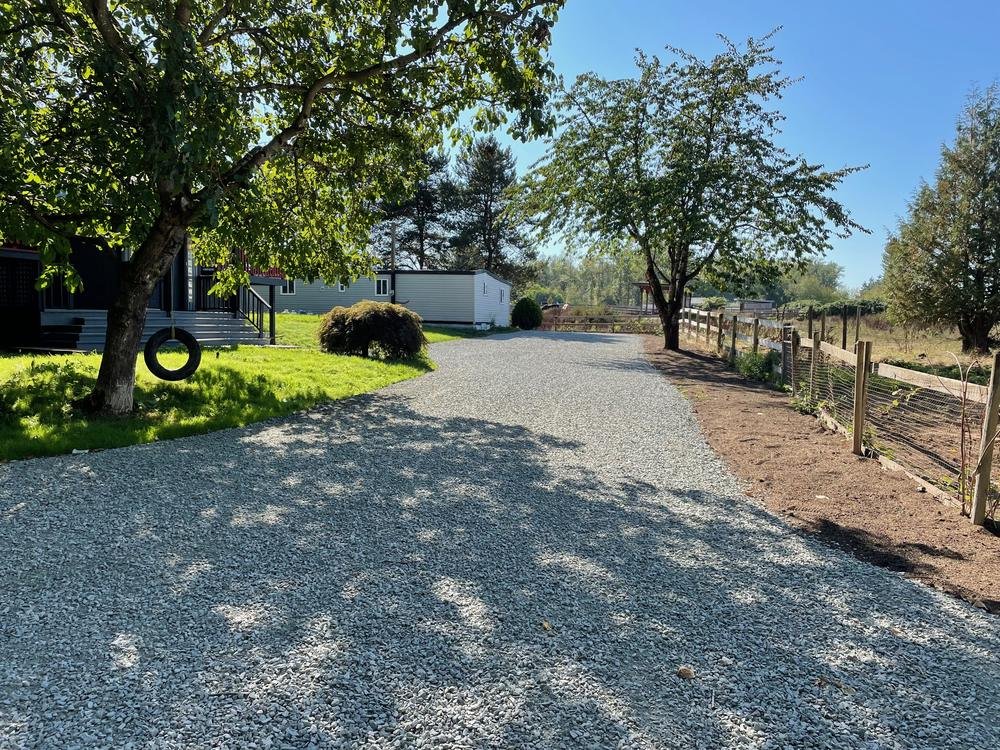
The driveway should shed water sideways, not carry it. That means a built crown across the width, ditching where the ground drains toward the drive rather than away from it, and culverts where water has to cross. Get this right and the surface stays where you put it. Get it wrong and every thaw takes material downhill.
Base course goes down and gets compacted in lifts, not dumped and bladed. On the Rathdrum Prairie you are frequently building on extremely permeable outwash gravel, which is a good subgrade and drains beautifully. In the Sagle and Cocolalla lowlands you may be on lake clay or compact till that holds water and heaves — different problem, different build, sometimes geotextile under the base.
Crushed rock with angular faces and enough fines locks up under traffic. Round river rock never does; it moves under tires forever, which is why a driveway of pretty round gravel is a driveway you will be raking.
A drive that only sees cars is not the same build as one that will carry a concrete truck, a loaded gravel truck, a fifth wheel or a fire apparatus. Tell us what is coming up it and we will build for that. Under-building the base is the single most common way to save money on a driveway and lose it.
Kootenai County's adopted frost line depth is 24 inches, and while that number is written for footings it tells you what the ground does here. Water trapped in a driveway base freezes, expands, lifts the surface, then melts and leaves a void. Repeat that through a North Idaho winter and you get the potholes everyone recognises. Everything above — crown, ditching, culverts, drainage, compaction — is aimed at not having water in there to freeze in the first place.
If your driveway meets a county road, you need an approach permit, and Kootenai County itself does not issue it. The county's roads are maintained by four independent highway districts — East Side, Lakes, Post Falls and Worley — and the permit comes from whichever one your road belongs to. For most of the north county, including Hayden, Dalton Gardens, Spirit Lake and Bayview, that is Lakes Highway District.
Their adopted standards set real requirements: driveway approach culverts of at least 12 inches diameter and 40 feet length unless the district directs otherwise, minimum stopping sight distances, and minimum approach spacing on arterials and major collectors. If your access is off a state highway — US-95, SH-41, SH-53 — the permit comes from Idaho Transportation Department District 1 instead. Inside city limits it is a right-of-way encroachment permit from the city.
Worth knowing before you plan a driveway: the highway district can dictate where your approach goes, based on sight distance and spacing from other approaches. That occasionally moves a driveway a considerable distance from where an owner wanted it. Better to find out at the design stage than after the base rock is in.
Not every tired driveway needs rebuilding. If the base is sound and the problem is surface wash, ruts or washboard, regrading and adding surface course puts it back. If the base was never right, or water has been running down the drive for years, adding rock to the top is money into a hole — literally. We will tell you which one you have.
A driveway is easier to plow if it was built to be plowed: a defined edge so the operator can see where it ends, room to push snow that is not into your septic drain field, and a surface that does not come up with the blade. Small decisions during construction that pay off every January.
Approach permit requirements cited here come from the Associated Highway Districts of Kootenai County Highway Standards, Lakes Highway District and Idaho Transportation Department District 1 published guidance; frost line depth from Kootenai County's adopted IRC amendments; and soils from the Idaho Geological Survey and NRCS. Requirements vary by district and by parcel — we confirm what applies before we build.
Drainage and base. Almost every driveway that fails here failed because water had nowhere to go or the base was too thin for what drove on it, and freeze-thaw makes both worse every year. A driveway that lasts has a built crown so water sheds sideways, ditching and culverts where water needs to cross, a properly compacted base built in lifts, and angular crushed rock that keys together rather than round rock that moves.
If it connects to a county road, yes — an approach permit. Kootenai County does not issue it; the four independent highway districts do. Most of the north county, including Hayden, Dalton Gardens, Spirit Lake and Bayview, is Lakes Highway District. Access off a state highway such as US-95, SH-41 or SH-53 is permitted by Idaho Transportation Department District 1, and inside city limits it is a right-of-way encroachment permit from the city.
The Associated Highway Districts of Kootenai County standards call for driveway approach culverts a minimum of 12 inches in diameter and 40 feet in length, or as directed by the highway district. The district can also dictate where the approach is located based on stopping sight distance and spacing from other approaches.
It depends on whether the base is sound. If the problem is surface wash, ruts or washboard over a good base, regrading and adding surface course fixes it. If the base was never built properly or water has been running down the driveway for years, adding rock on top is money in a hole. We will tell you which one you have rather than selling you the easy answer.
Crushed rock. Angular faces and enough fines let the surface lock up under traffic. Round river rock never keys together — it moves under tires indefinitely, which means you will be raking it back into place for as long as you own it.
Get a free, no-obligation estimate. Honest pricing, clear timelines, and work you can count on.
Get My Free Estimate