Anyone with a machine can knock a building down. What separates a demolition job that goes smoothly from one that stalls is the week before the machine shows up: utilities located and disconnected, the asbestos question answered, the permit in hand, disposal arranged, and a plan for what the site needs to look like when we leave.
We handle that sequence as part of the job, and we tell you which pieces are ours and which are yours before we start. Nobody likes finding out on demo day that the power drop is still live or that the landfill will not take the load.
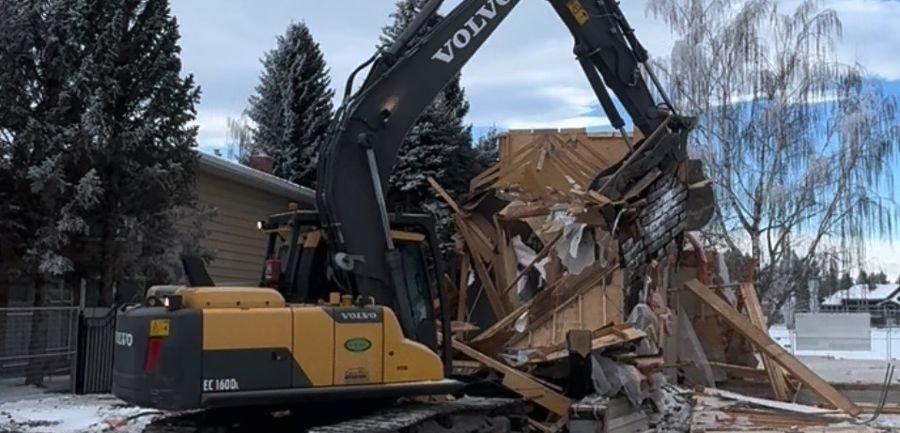
Houses, mobile homes, shops, barns, sheds and outbuildings. Concrete slabs, foundations and stem walls. Old asphalt and failed gravel driveways. Decks, fences and burn piles. Abandoned septic tanks, which have their own decommissioning rules. Partial demolition too — taking an addition off, pulling a slab out of a shop, or clearing a footprint while leaving the rest of the property alone.
Idaho’s asbestos rules run through the Department of Environmental Quality, and demolition projects carry a notification requirement with a ten working day clock before work starts. Regulated asbestos-containing material triggers the full requirements at roughly 260 linear feet of pipe insulation, 160 square feet of surfacing material, or 35 cubic feet of debris. Older structures around here — anything with vermiculite in the attic, sheet flooring, popcorn ceiling texture, or wrapped duct and pipe — are worth testing before a bucket touches them.
This is the single most common reason a demolition slips. The ten working day clock does not start when you decide to tear it down, it starts when the notification is filed. If you know a structure is coming down next month, ask about the survey now — it costs a fraction of what a stop-work order does.
We are not an abatement contractor and we do not pretend otherwise. What we do is tell you when the question applies, work with whoever you hire to test or abate, and schedule around their clock.
Power, gas, water and septic all get dealt with before demolition, and most of those calls have to come from the account holder — the utility will not take them from us. Underground locates go through Idaho’s dig line, which wants two business days notice and gives marks that stay good for about four weeks. Well and septic components on the property get identified so they do not become a surprise. If there is a permit required for the demolition itself, that comes from the jurisdiction that would have permitted the building.
Out. Sorted as it comes down — metal one place, clean wood another, concrete and asphalt separated where there is enough to be worth it, and the rest to the landfill. Separating at the machine rather than at the scale is what keeps tipping costs down, and it means the recyclable steel actually gets recycled instead of buried. Burning construction and demolition debris is not a disposal plan here, and we will not do it.
That depends on what you are doing next, and it is worth deciding before we start. A lot that is going back to lawn gets backfilled, graded and left ready to seed. A lot that is getting a new building gets the hole left open or backfilled with compactable material depending on the plan — and it matters, because rubble-filled ground is not something you can build on. If you are rebuilding on the same footprint, say so early; it changes how we take the old one out.
Square footage and what it is built of, whether it has a basement or a slab, what utilities are still connected, how close the neighbors and the trees are, and what you want the ground to look like when we are done. We come look, it is free, and the number you get is written down.
Asbestos notification timing and the regulated material thresholds cited here come from Idaho Department of Environmental Quality air quality compliance guidance implementing the federal asbestos NESHAP; excavation locate timing from Idaho Code Title 55, Chapter 22. Permit requirements for demolition vary by jurisdiction, and abatement and survey work is performed by licensed specialists, not by us.
Often yes, from whichever jurisdiction would have permitted the building — the county, or the city if you are inside limits. Separately, Idaho DEQ’s asbestos notification applies to demolition projects on its own clock. We will tell you what your project needs, but the permit is pulled in the owner’s name.
Ten working days must pass after the notification is filed before demolition starts. That is the piece that catches people out, so if a structure is coming down, get the survey and the paperwork moving early — the tear-out itself is often a day or two.
An abandoned tank cannot just be left in the ground. It gets pumped and then either removed or crushed and filled so it cannot collapse later, and Panhandle Health District has requirements for how that is done. We handle it as part of the demolition and coordinate the pumping.
Yes. Taking an addition off, removing a slab from inside a shop, pulling a chimney, or clearing one structure while leaving the rest of the property untouched. Selective work is slower per square foot than dropping a whole building, so it prices differently — we will be straight with you about that.
Yes, that is part of the job unless you want something kept — salvage lumber, metal, a slab you would rather break and reuse for fill. Tell us before we start and we will set it aside. Otherwise the debris is sorted, loaded and disposed of, and the price we quote includes the tipping.
Get a free, no-obligation estimate. Honest pricing, clear timelines, and work you can count on.
Get My Free Estimate