A utility trench is the one part of a project that is genuinely hard to fix later. Once it is covered, a line that is too shallow, bedded on rock, or run without warning tape stays that way until something fails and somebody digs it up. So the sequence matters more than the speed: locate, dig to the right depth, bed it, lay it, get it inspected if it needs to be, tape it, and backfill in compacted lifts.
Do that and the trench is invisible for forty years. Skip a step and it becomes the reason your driveway has a sinkhole in it, or the reason the next contractor puts a bucket through your water line.
Idaho law runs underground locates through the state dig line, and the excavator has to give not less than two business days and not more than ten business days notice before digging. Once the marks are down they stay good for about four consecutive weeks provided site conditions have not changed materially. We make that call on our own jobs — it is our responsibility, not yours — and we will not put a tooth in the ground before the marks are in.
Locates cover public and utility-owned facilities. They do not cover what a previous owner buried on private property — the old well line, the irrigation main, the power run to the shop somebody did themselves in 1994. If you know about any of that, tell us. If you suspect it, tell us anyway and we will pothole by hand where it matters.
Water service from the well or the meter to the house. Power and communications conduit to a shop, a barn, a pump house or a gate. Sewer and septic lines, including the run between the tank and the drain field. Gas line trenches for the utility or your licensed installer to lay in. Roof and footing drains, French drains, culverts and the surface work that keeps water away from a building.
Water lines go below frost, and Kootenai County’s adopted code puts the frost line at twenty-four inches — most water service around here is set deeper than that for margin, because a line at exactly the minimum is a line that freezes in a hard winter with no snow cover. Power and communications depth comes off the utility’s own specification, not off a rule of thumb, and it differs between providers and between conduit types.
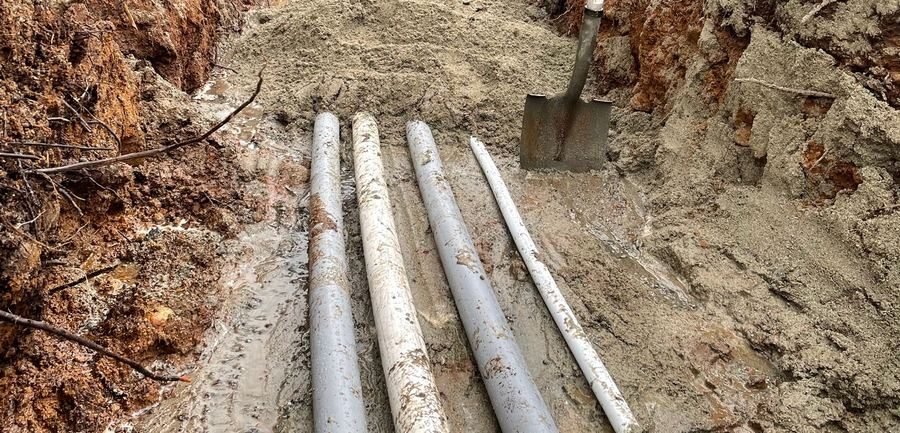
Bedding matters as much as depth. Our native ground is full of cobble, and pipe laid straight onto rock develops point loads that split it years later. Sand or screened bedding under and over the line, warning tape above it, then backfill in lifts — compacted, not pushed in and left to settle on its own under whatever you build on top.
Past five feet deep, a trench has to be sloped, benched or shored before anyone enters it. Our sand and gravel soils will not hold a vertical wall, and trench walls fail without warning. It is a federal safety standard, we work to it, and it is part of why a deep trench takes more room on your property than the width of the pipe suggests.
We open the ground, install what we are licensed and qualified to install, and stage the rest for the trade that owns it. Electrical connections are made by a licensed electrician, plumbing connections by a licensed plumber, gas by the utility or its approved installer, and septic work under the permits Panhandle Health District issues. We coordinate the schedule so the trench is open when they need it and closed as soon as it is signed off — an open trench sitting for a week is a hazard and a liability.
Where it starts, where it ends, what is going in it, and what is between the two — driveway, lawn, trees, rock, a slope, an existing septic field. Length and depth drive the number, and surface restoration is worth talking about before we start rather than after.
Locate notice periods and marking validity cited here come from Idaho Code Title 55, Chapter 22 (Idaho Underground Facilities Damage Prevention); frost line depth from Kootenai County’s adopted International Residential Code climatic design criteria; trench protective-system requirements from federal OSHA excavation standards. Utility-specific burial depths are set by each provider, and licensed trades make their own connections.
We do, on our own work — the notice is the excavator’s responsibility under Idaho law, and it has to be in not less than two business days before we dig. What helps enormously is anything you know about private lines that locates will not mark: old irrigation, a well line, power somebody ran to a shop years ago.
Below frost, which is a twenty-four inch frost line in Kootenai County, and in practice deeper for margin — a line sitting right at the minimum is the one that freezes in a cold snap with no snow on the ground. Power and communications depth comes from the utility’s own spec sheet, which varies by provider.
Sometimes, with the required separation and in the right configuration — and sometimes not, depending on the utility’s rules. It can save real money when it is allowed, so it is worth asking before we dig two trenches. We confirm with the provider rather than guessing.
Tell us what you expect before we start. A trench across a gravel drive gets backfilled, compacted and re-rocked so it does not settle into a rut. Lawn gets backfilled, compacted and raked back to grade, though the scar shows until it grows in. Crossing asphalt or concrete means a saw cut and a patch, which we price separately.
We install what we are qualified to install and open the ground for everyone else. Electrical connections are a licensed electrician’s, plumbing a licensed plumber’s, gas the utility’s, and septic work runs under Panhandle Health District permits. We schedule the trades so the trench is open when they arrive and covered as soon as it passes.
Get a free, no-obligation estimate. Honest pricing, clear timelines, and work you can count on.
Get My Free Estimate